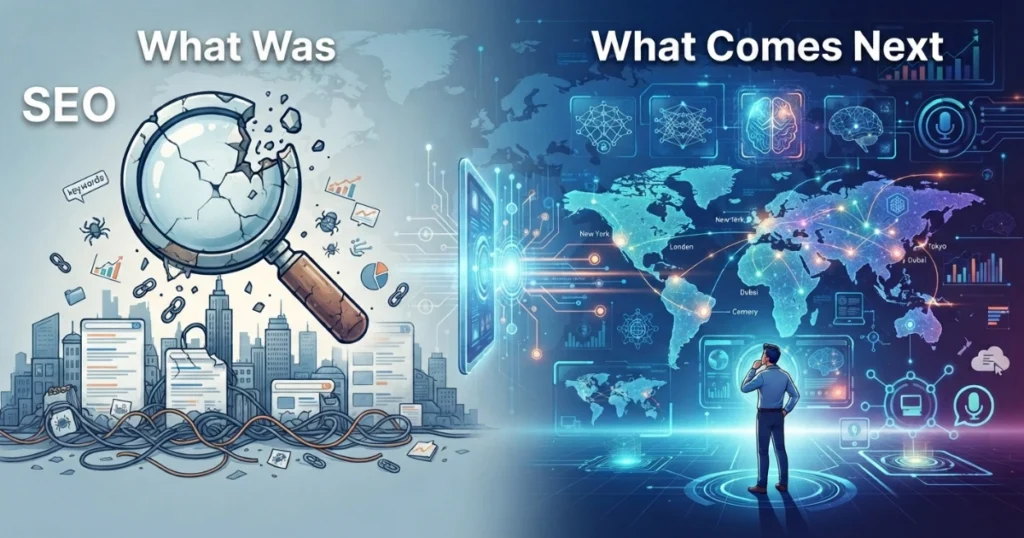
Is SEO dead? The short answer is no. Then what comes next in global markets? This question has become a concern for SEO professionals, digital marketers, website owners, and businesses worldwide. This is a burning question for those new to SEO, those who want to learn, or those who want to build a career in search engine optimization.
This panic about SEO is not entirely unfounded. Google has introduced AI insights throughout its core search experience, and zero-click searches for informational searches have become commonplace. So when someone searches Google for “what is seo,” they get the answer right on the search results page, no clicks required.
On top of that, platforms like Gemini, TikTok, ChatGPT, and Claude are becoming major players in how people discover information. The search queries have fragmented. Users now research on Meta, ask ChatGPT, Quora, read Reddit threads, and check Google Maps before they ever land on your website.
So, it’s easy to understand why people worldwide are asking whether SEO is still important.
The Evolution of SEO in Global Markets
People worldwide still search for businesses, products, services, reviews, solutions, and information every day. Search engines still need high-quality websites and content to understand what businesses offer.
The real change is that old SEO tactics are becoming less effective.
Keyword stuffing, low-quality backlinks, thin content, duplicate pages, and content created solely for search engines are increasingly poor strategies. The latest search optimization requires genuine expertise, useful information, strong technical foundations, and a positive user experience.
Therefore, SEO is not disappearing. SEO is evolving.
What the latest SEO strategies increasingly need to include:
✅ AI search optimization
✅ Generative Engine Optimization (GEO)
✅ Answer Engine Optimization (AEO)
✅ Search Experience Optimization (SXO)
✅ Local SEO
✅ Technical SEO
✅ Content marketing
✅ Digital PR & brand authority
✅ Entity & topical optimization
✅ Conversion rate optimization
How is AI search changing the way people find information?
One of the biggest advancements in digital marketing is the rise of AI-powered search. Instead of clicking through multiple search results, users are increasingly getting answers directly from multiple sources.
This presents a new challenge and an ongoing opportunity for businesses or brands: How can your business be visible among the answers generated by AI? This is where generative engine optimization (GEO) becomes increasingly important.
GEO focuses on improving the abilities of a brand to be found, understood, mentioned, and accurately represented through AI-powered search experiences. Professionals can strengthen business visibility by publishing authoritative content, demonstrating expertise, maintaining consistency in business information, and building a credible online presence.
SEO and GEO should not be viewed as competing strategies. Rather, both strategies can work together as part of a larger search visibility strategy.
How do primary keywords consistently help in current searches?
Businesses targeting global or local markets should continue researching and optimizing for relevant primary keywords. However, keyword selection must be aligned with current search intent. In this case, these keywords help establish topical relevance when used naturally across different pages and content on the website.
For example, important primary keywords for an SEO agency may include:
✅ SEO
✅ Search engine optimization
✅ Global SEO
✅ SEO services
✅ Digital marketing
✅ SEO strategy
✅ AI SEO
✅ International SEO
✅ SEO agency
✅ Search marketing
How will secondary keywords continue to help with SEO success?
Secondary keywords provide additional context to content or a website and help businesses address different variations of user searches. Rather than forcing these keywords into content, experts should align them naturally where they genuinely answer user questions.
For example, important secondary keywords for an SEO agency may include:
✅ Is SEO dead?
✅ Future of SEO
✅ SEO trends
✅ SEO in the AI era
✅ AI search optimization
✅ Google search optimization
✅ SEO for global businesses
✅ International search engine optimization
✅ SEO content strategy
✅ SEO ranking factors
✅ Organic search traffic
✅ Search visibility
✅ SEO best practices
✅ Modern SEO strategies
✅ Future of digital marketing
How do semantic keywords and their thematic relevance work in SEO?
Search engines increasingly understand topics, entities, relationships, context, and intent. This makes semantic SEO an important component of a comprehensive content strategy. Using semantically related concepts helps search engines understand the depth and relevance of a webpage instead of relying solely on exact keyword matches.
Relevant semantic keywords for primary keyword SEO may include search intent, organic visibility, content quality, topical authority, E-E-A-T, backlinks, website authority, and user experience. It may also include helpful content, crawling, indexing, structured data, technical SEO, and internal linking. It can also include brand mentions, entity SEO, AI search, answer engines, generative search, local search, conversion optimization, and digital authority.
Semantic keywords align topical relevance in SEO, including:
✅ Improves Search Context
✅ Supports Topical Authority
✅ Expands Keyword Coverage
✅ Improves Content Relevance
✅ Targets User Intent
✅ Builds Topic Clusters
✅ Improves Semantic Understanding
✅ Reduces Keyword Stuffing
✅ Supports Long-Tail Searches
✅ Strengthens SEO Performance
Why Human Expertise Still Matters and Will Continue to?
AI can help professionals research topics, identify content gaps, generate ideas, analyze data, and improve productivity. However, AI-generated automated content alone does not guarantee search visibility or trust. This is particularly important for websites or businesses operating in competitive global markets.
A website needs more than words, images, or videos. It needs evidence that the user understands its industry, context, and can provide real value to customers.
Human expertise remains essential for creating content that ensures:
✅ First-hand experience
✅ Genuine expertise
✅ Accurate information
✅ Original insights
✅ Industry knowledge
✅ Trustworthiness
✅ Clear opinions & recommendations
Why E-E-A-T Is More Important Than Ever and Will Be?
Experience, Expertise, Authoritativeness, and Trustworthiness—commonly referred to as E-E-A-T- are the most important frameworks in SEO for creating credible online content.
Businesses should strengthen their E-E-A-T signals by showing qualified authors, company experience, and customer reviews. It should also include case studies, original research, transparent business information, credentials, and trustworthy references.
In competitive industries, strong brand authority can be a key differentiating factor in terms of user trust and search engine results page (SERP) rankings.
10 reasons why E-E-A-T will remain important in the future:
✅ Builds User Trust
✅ Demonstrates Expertise
✅ Highlights Real Experience
✅ Strengthens Authority
✅ Improves Credibility
✅ Supports Helpful Content
✅ Matters for AI Search
✅ Reduces Misinformation
✅ Supports Long-Term SEO
✅ Genuine Will Remain Essential
Why Technical SEO Still Matters and Will Continue to?
Technical SEO remains essential for long-term website search visibility and will continue to matter as search evolves. A technically optimized website helps search engines crawl, understand, and index pages smoothly while improving user experience, site speed, mobile performance, security, and accessibility. A website with strong technical SEO also supports traditional search engines and AI-driven discovery platforms.
Website owners should pay attention to:
✅ Website speed
✅ Mobile usability
✅ Core Web Vitals
✅ Crawlability & Indexation
✅ XML sitemaps
✅ Canonical URLs
✅ Structured data
✅ HTTPS security
✅ Website architecture
✅ Internal linking & Broken links
Why Local SEO Remains Powerful & Will?
Local SEO will continue to provide valuable opportunities for businesses that serve specific geographic areas. Customers still search for phrases such as “SEO agency near me,” “digital marketing agency in Dhaka,” or “best SEO company in Bangladesh.”
Optimizing Google Business Profile information, local landing pages, reviews, business citations, location-specific content, and consistent NAP information will help improve a business’s local visibility.
Local SEO is particularly valuable for service businesses that depend on customers within specific cities, locations, regions, or countries.
10 reasons why local SEO will remain powerful:
✅ Boosts Local Visibility
✅ Targets “Near Me” Searches
✅ Drives Qualified Traffic
✅ Strengthens Google Business Profiles
Builds User Local Trust
✅ Improves Mobile Discovery
✅ Supports Voice Search
✅ Increases Store Visits
✅ Creates Competitive Advantage
✅ Delivers Long-Term Value
What Hasn’t Changed at All Worldwide – The Opportunities for SEO
Despite all the noise, some things remain constant:
✅ People still have problems they need to solve, and they still type those problems into a search box.
✅ High-intent searches still get clicked. “Best HRM for a five-person sales team in real estate” still gets clicked. “What is an HRM?” doesn’t.
✅ Trust still wins. A business that shows up consistently with helpful content, real case studies, and a credible point of view will outrank a faceless content farm.
✅ Organic search still delivers a significantly better ROI than paid media over a meaningful time horizon.
The Future of SEO: When Search Everywhere in Evolving Search Engines Worldwide!
The future of search is unlikely to be about Google alone. Search is becoming more distributed across multiple platforms and probably will continue to. This gives rise to a broader concept: Search Everywhere Optimization. SEO professionals should create digital assets that can be found across multiple channels, rather than relying solely on a search engine.
Users may discover a business or information through:
✅ Google
✅ Bing
✅ AI search engines
✅ ChatGPT
✅ YouTube
✅ Social media
✅ Online marketplaces
✅ Maps
✅ Voice assistants
✅ Industry directories
✅ Community platforms
What should businesses do next in the evolving search environment?
Businesses and professionals shouldn’t abandon SEO just because search patterns are changing. Instead, they should modernize their SEO strategies. A future-ready strategy should combine technical SEO, helpful and unique content, semantic SEO, E-E-A-T, local SEO, digital PR, brand building, GEO, AEO, and SXO.
Companies or website owners should also monitor changes in search behavior, analyze website performance, update outdated content, and strengthen their topical authority. It should also include genuinely useful resources for their target audiences.
The goal should no longer be only to “rank #1.” The bigger objective is to become the trusted answer and recognizable brand or information wherever customers search.
Don’t Just Rank – Get Discovered. Your customers are searching. The question is: Will they find your website, brand, data, or your competitors?
The Truth: SEO Is Evolving, Not Dying Anyway
Here’s what the data actually shows about the burning question:
☑️ The global SEO services market is expected to grow from $92.74 billion in 2025 to $108.28 billion in 2026, at a compound annual growth rate of 16.8%.
☑️ Organic search still accounts for more website traffic than paid search across most industries worldwide.
☑️ 68% of global web traffic still comes from organic search worldwide.
☑️ 72% of SMBs say their website SEO performance is either very or somewhat effective.
The SEO strategy isn’t broken. Some approaches to the strategies are. As one industry expert mentioned it: “The SEO strategy that some teams were running five years ago is dead, and that’s a meaningful distinction.” Not the end.
Future of SEO with Digital Dhaka 360
So, is SEO dead? Absolutely not. Traditional SEO tactics may be changing, but organic search, content discovery, brand visibility, and search-driven customer acquisition remain highly valuable and will continue.
The future belongs to SEO experts who combine human expertise with technology, data, high-quality content, technical excellence, and multi-platform search optimization.
Digital Dhaka 360 helps businesses and website owners navigate this changing environment with updated SEO strategies. It includes around human-first content, E-E-A-T, technical SEO, local SEO, content optimization, GEO, AEO, and sustainable organic growth.
SEO is not dead; it is becoming broader, smarter, and more competitive worldwide. The businesses that adapt today will be better positioned to win visibility in tomorrow’s global searches. What’s changed in SEO is what works. And that’s exactly where Digital Dhaka 360 comes in.
Let Digital Dhaka 360 help you:
✅ Increase organic search visibility
✅ Attract qualified website traffic
✅ Build topical authority and brand trust
✅ Improve Google rankings
✅ Optimize your website for AI-powered search
✅ Generate more qualified leads and conversions
✅ Expand your reach into global markets
✅ Build a sustainable long-term SEO strategy
The Bottom Line
SEO is not dead. It is evolving. Businesses or websites that adapt and focus on brand visibility, customer trust, and high-intent search opportunities will be better positioned to win than those still chasing rankings alone.
The question isn’t “Is SEO dead?” The real question is: “Is your current SEO strategy working for your business?”
If the answer is “I’m not sure” or “Probably not,” it’s time to talk to SEO experts.
Frequently Asked Questions (FAQ)
Is SEO dead now?
No. SEO is not dead. It has evolved into Generative Engine Optimization (GEO). While old spam tactics are dead, strategic SEO that builds trust and authority is more valuable than ever.
Does AI like ChatGPT replace SEO?
No. AI models rely on SEO-optimized websites to generate their answers. If your site isn’t optimized, you won’t exist in AI results. SEO is the foundation that fuels AI.
How much does SEO cost in Bangladesh?
Costs vary based on the scope. Digital Dhaka 360 offers transparent, customized packages starting with competitive rates with no hidden fees. Contact us for a tailored quote.
How long does SEO take to show results?
With the new AI era, you can see initial visibility improvements in 3 to 6 months. However, brand authority and “AI citations” usually take 6 to 12 months of consistent effort.
Ready to Future-Proof Your SEO?
Whether you’re a local business looking to dominate search results in Bangladesh, an e-commerce brand targeting international customers, or a growing company preparing for the AI-powered search era.
The Digital Dhaka 360 team is ready to help you build a data-driven SEO strategy that aligns with your business goals.
Don’t let outdated SEO tactics hold your business back. Let Digital Dhaka 360 help you build an SEO strategy that works today and keeps working as the search continues to evolve.
🚀 Get a free SEO audit and discover exactly where your website stands.
📞 Contact us today and start dominating Google & AI searches.
🌐 Visit us at: https://digitaldhaka360.com
Stop chasing traffic. Start dominating it organically.
Digital Dhaka 360 – Bangladesh’s Best SEO Agency