
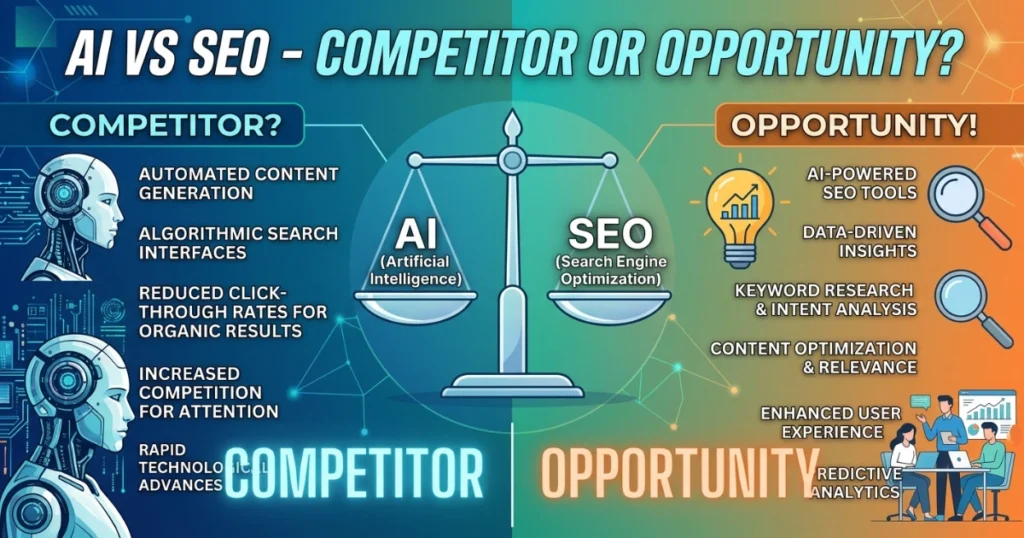
AI vs SEO – Competitor or Opportunity? Is AI a competitor to SEO? Artificial intelligence (AI) is transforming digital marketing strategies worldwide. AI has changed the way people search for information and how search engines evaluate content. At the same time, SEO (Search Engine Optimization) remains one of the most powerful strategies for improving the online visibility of information or websites and attracting organic traffic. This raises an important question for businesses, individuals, or SEO professionals: Is AI a competitor to SEO?
AI vs SEO – Understand the Difference Between
SEO is a digital marketing strategy that helps increase a website’s visibility, user engagement, and traffic from search engine results. It includes keyword research, content optimization, technical SEO, link building, local SEO, user experience, website performance monitoring, and optimization.
On the other hand, AI is a technology that can analyze large amounts of data, identify patterns, generate content, and understand language. It provides online users with quickly updated information and helps them make decisions.
Therefore, AI should be seen as both a collaborative tool for SEO professionals and a technology that is positively changing the online search.
AI vs SEO – Difference Between:
✅ AI focuses on automation, analysis & intelligent assistance
✅ SEO focuses on improving website visibility in search engines
✅ AI can support & improve SEO strategies
✅ SEO focuses on keywords, content, links & technical improvements
✅ AI can analyze large amounts of SEO data quickly
✅ SEO goals to attract organic search traffic
✅ AI helps create & optimize content more efficiently
✅ SEO prioritizes search intent & user behavior
✅ AI improves research, analysis & workflow automation
✅ SEO combines more with human-led SEO expertise
Is AI Replacing Traditional SEO?
AI is not replacing SEO strategies, but it is inspiring adaptations to traditional SEO practices. Search engines are also increasingly using artificial intelligence to understand search queries, content quality, context, entities, and user intent.
Traditional SEO focuses heavily on keywords and SERP rankings. Search engines are now more efficient at identifying useful, relevant, and trustworthy content.
This means, in the AI era, businesses cannot simply publish large volumes of AI-generated content and expect higher search engine rankings.
Now SEO requires a much broader approach, including:
✅ Search intent
✅ Content quality
✅ Topical authority
✅ User experience
✅ E-E-A-T
✅ Semantic relevance
✅ Website performance
✅ Helpful & original content
✅ Brand authority
✅ Entity relationships
✅ Structured data
The Zero-Click Reality: Is SEO Losing Clicks to AI?
The rise of artificial intelligence (AI)-powered search systems is transforming the way people search for and consume information online. A significant shift in this regard is the increase in “zero-click searches.” Users obtain the information they need directly from the search results without visiting a website.
AI-generated answers, featured snippets, knowledge panels, local results, and other search features can provide users with quick answers before they even click on any organic search results.
This has raised an important question for SEO professionals and website owners: Is SEO losing clicks to AI?
The answer is partly yes, but that does not mean SEO is becoming irrelevant. Instead, SEO is evolving.
Traditional SEO has often focused on ranking websites on search engine results pages (SERPs) and generating organic clicks. In the AI search era, businesses also need to focus on visibility, brand credibility, brand recognition, citations, and being included in AI-generated answers.
Why Are Zero-Click Searches Increasing Worldwide?
Users increasingly want fast, accurate, and convenient answers online. Instead of opening several websites to find information or data, they may receive an answer directly within Google or an AI-powered search platform.
This change can reduce clicks for some informational searches, particularly simple queries such as definitions, quick facts, basic comparisons, or straightforward question answers.
However, ‘zero-click visibility,’ or being visible without requiring a direct click, can also offer valuable promotional opportunities. When the name of a business, website, or brand appears in search results or AI-generated answers, users can learn about the brand even without immediately clicking through to the website. This helps improve brand awareness, authority, and credibility.
Does Zero-Click Search Mean SEO Is Dead?
No. SEO is not dead; the definition of successful SEO is changing.
Search engines and AI systems still need reliable information to understand topics, businesses, products, services, and websites. Strong SEO helps search engines discover, crawl, understand, and evaluate website content.
SEO professionals and website owners should therefore move beyond focusing only on SERp rankings and clicks. An SEO strategy should build topical authority, E-E-A-T signals, high-quality content, strong internal linking, structured information, relevant entities, and trustworthy online references.
The SEO goal is no longer simply to rank at the top. It is to make your brand visible wherever your potential customers are searching.
The Changes From Ranking for Clicks to Earning Visibility!
The zero-click search environment brings a new opportunity for SEO professionals and businesses. Your content can potentially appear in featured snippets, AI-generated answers, People Also Ask results, local search results, and other online search experiences.
This is where Answer Engine Optimization (AEO) and Generative Engine Optimization (GEO) are becoming important alongside traditional SEO.
A strong SEO strategy should provide direct answers to important customer questions while demonstrating expertise, experience, authority, and trustworthiness. Well-structured website content also makes it easier for search engines and AI systems to understand and use your information.
How Website or Business Owners Can Adapt to the Zero-Click Era:
✅ Creating original, useful & experience-based content
✅ Answering specific customer questions clearly & directly
✅ Building topical authority around important business subjects
✅ Strengthening E-E-A-T signals & brand credibility
✅ Optimizing content for AI featured snippets & question-based searches
✅ Using clear headings & structured content
✅ Improving internal linking & website information architecture
✅ Accurate business, NAP & entity information across the web
✅ Optimizing for local search & Google Business Profile
✅ Combining traditional SEO with AEO and GEO strategies
✅ Building a recognizable website or trustworthy brand, not just chasing keywords
The Future of SEO Is Brand Visibility, Not Just Clicks!
The reality of ‘zero-click’ does not mean that SEO has become ineffective or that website owners or businesses should stop investing in it. Instead, it means they need to measure SEO success more broadly.
Organic traffic and SERP rankings remain important, but website owners should also consider impressions, branded searches, SERP visibility, conversions, mentions, citations, leads, and overall brand presence.
AI is changing the search journey, but it still depends on information shared and published across the web. Websites that consistently produce helpful, authoritative, original, and well-optimized content can position themselves for both traditional search and emerging AI-powered search experiences.
SEO is not disappearing because of AI. It is expanding. Website owners who adapt their SEO strategy to the zero-click and AI search environment will be better positioned to maintain SERP visibility. It will help build their brand authority and reach customers across evolving searches.
How AI Can Help Improve SEO Goals
AI can help SEO professionals achieve SEO goals faster by supporting keyword research, content planning, competitor analysis, technical SEO, and site performance monitoring. AI-powered SEO tools help identify user search intent, discover content gaps, optimize existing pages, and improve semantic relevance. When combined with human expertise, AI helps improve content quality, enhance user experience, and support long-term site performance.
1. AI-Powered Keyword Research
AI can simplify keyword research by analyzing user search intent, keyword trends, related queries, long-tail keywords, and competitor strategies. AI-powered SEO tools help you quickly identify high-value keyword opportunities, semantic terms, and content topics better. By combining AI insights with human expertise, it can create precise keyword strategies, improve organic rankings, attract qualified traffic, and strengthen overall SEO performance.
For example, instead of targeting only “SEO agency,” an AI-assisted keyword strategy can quickly identify more related terms such as:
✅ SEO services
✅ Professional SEO company
✅ Local SEO services
✅ Technical SEO
✅ Organic search optimization
✅ SEO content strategy
✅ Google search ranking
✅ AI SEO tools
2. Faster Content Research
AI tools like Gemini and ChatGPT help speed up content research by analyzing search trends, competitors, keywords, questions, and relevant topics in seconds. It also helps identify content gaps, strategies, organize research, and generate useful topic cluster ideas. When combined with human expertise and fact-checking, AI-powered tools enable professionals to develop accurate, relevant, comprehensive, and SEO-ready content more efficiently.
Tips to Use AI for Faster Content Research:
✅ Generate Topic Ideas Quickly
✅ Find Relevant Keywords
✅ Analyze Search Intent
✅ Create Content Outlines
✅ Summarize Research Sources
✅ Identify Content Gaps
✅ Organize Research Findings
✅ Verify Important Information
3. Content Optimization
AI tools can support content optimization by analyzing user search intent, identifying keyword opportunities, improving readability, and finding content gaps. AI-powered SEO tools help suggest more relevant headings, semantic keywords, internal linking opportunities, and content strategy improvements. Combined with human expertise, AI tools help develop valuable, well-structured, search-friendly content optimization to improve organic visibility, user engagement, and SEO performance.
AI tools help analyse content and identify opportunities to improve:
✅ Headings
✅ Keyword coverage
✅ Search intent
✅ Readability
✅ Internal linking
✅ Topic depth
✅ Content structure
✅ Frequently asked questions
4. Technical SEO Assistance
AI-powered tools can also assist with technical SEO improvements for your website. It helps identify potential issues related to crawling, indexing, metadata, redirects, broken links, structured data, and overall existing errors. By analyzing overall website performance, AI tools can help SEO teams analyze large websites faster and more efficiently. However, technical recommendations for a site should always be reviewed by experienced professionals.
Tips to Use AI for Technical SEO Improvements:
✅ Identify Crawl Errors
✅ Improve Site Structure
✅ Optimize Page Speed
✅ Find Duplicate Content
✅ Analyze Meta Tags
✅ Check Mobile SEO
✅ Improve Schema Markup
✅ Monitor Technical Issues
How AI Is Changing Online Search Results
One of the biggest changes for SEO professionals is the emergence of AI-powered search and answer engines. Users now increasingly ask conversational questions and receive summarized answers rather than browsing multiple traditional search results.
This update creates both new opportunities and challenges for content creators, SEO professionals, and marketers.
The goal is no longer confined to ranking for a keyword. The strategy is to become a trusted source that search engines and AI systems can understand, recognize, and potentially reference.
SEO is therefore expanding beyond traditional Google rankings. Professionals should also consider:
✅ AI search visibility
✅ Answer Engine Optimization (AEO)
✅ Generative Engine Optimization (GEO)
✅ Search Experience Optimization (SXO)
✅ Brand mentions
✅ Entity optimization
✅ Structured data
✅ Content authority
AI SEO – Competitor or Opportunity for Professionals?
AI-powered tools like Google Gemini or ChatGPT can certainly create competition for traditional SEO methods. For example, AI-automated content generation has made it easier for businesses to publish thousands of pages. However, more content does not automatically mean better SERP rankings.
Human SEO professionals provide what AI-powered tools alone cannot reliably guarantee: experience, judgment, creativity, originality, business understanding, and strategic decision-making.
The real competitive advantage comes from combining AI tools assistance with human expertise.
An AI SEO Strategy Can Provide:
✅ Faster research
✅ Better content planning
✅ Efficient keyword analysis
✅ Automated reporting
✅ Improved content optimization
✅ Faster competitor analysis
✅ Scalable SEO workflows
✅ More personalized content strategies
Why Does Human Expertise Always Matter Most in SEO?
AI-powered tools can produce content faster, but speed and quality are not the same. Successful SEO strategies demonstrate real human expertise and provide value beyond what is already available online.
Human experts can add original insights, real-time examples, case studies, first-hand experience, opinions, and practical recommendations. This particularly aligns with E-E-A-T: Experience, Expertise, Authoritativeness, and Trustworthiness.
Instead, AI should assist the SEO team while humans remain responsible for accuracy, uniqueness, usefulness, originality, creativity, and brand voice.
10 Reasons Why Human Expertise Always Matters:
✅ Human expertise builds trust & credibility
✅ Experts understand real audience needs
✅ Humans provide unique insights & experiences
✅ Expertise helps create accurate & valuable content
✅ Human judgment improves keyword targeting
✅ Experts can identify search intent effectively
✅ Humans ensure content reflects brand expertise
✅ Expert review reduces AI-generated inaccuracies
✅ Human creativity makes content more engaging
✅ Strong expertise supports E-E-A-T & long-term SEO
AI Vs Traditional SEO Strategies
AI vs. traditional SEO strategies highlight how search optimization is changing day by day. Traditional SEO focuses more on keywords, backlinks, technical optimization, and Google rankings. AI-powered SEO uses automation, search intent analysis, semantic optimization, content insights, and predictive data.
Combining both approaches helps websites improve organic visibility, create relevant content, improve user experience, and build sustainable search performance.
The difference between traditional SEO Strategies and AI-driven SEO as follows:
Feature | Traditional SEO | AI-Driven SEO |
Primary Focus | Optimizing for exact keyword match and search engine crawlers | Understand user search intent, semantics, and context |
Keyword Research | Manual identification of search volumes, difficulty, and broad keywords | Predictive analysis, clustering semantic entities, and long-tail conversational intent |
Content Creation | Written manually by content creators based on targeted keyword density | AI-assisted generation, real-time optimization, and automated content brief creation |
On-Page Optimization | Fixed meta tags, static alt tags, manual internal linking, and heading structures | Dynamic content suggestions, programmatic internal linking, and real-time page adjustments |
User Experience (UX) | Standard site speed optimization, mobile responsiveness, and layout hierarchy | Personalization, behavioral adaptation, and predictive UX flow recommendations |
Data Analysis | Historical traffic performance, Google Analytics reports, and manual auditing | Real-time predictive analytics, automated competitor pattern detection, and anomaly alerts |
Search Engine Target | Traditional SERPs ( blue links, featured snippets) | Generative engine optimization (GEO), AI Overviews (SGE), and conversational engines (ChatGPT, Gemini) |
Extensibility & Speed | Slow, labor-intensive processes requiring ongoing manual work | Highly flexible, fast execution, and automated workflow integration |
How To Adapt Between AI & SEO?
Professionals should not choose between AI and SEO; they should combine both for stronger online success. Use AI-powered tools for keyword research, content planning, competitor analysis, automation, and better SEO insights. Apply human expertise to ensure data accuracy, content originality, user trust, and site relevance.
A balanced AI SEO strategy can improve a site’s search visibility, organic traffic, user experience, and long-term online performance.
A Sustainable SEO Strategy Should Include:
✅ Build a strong technical SEO foundation
✅ Research keywords & search intent
✅ Create original & helpful content
✅ Use AI to accelerate research & analysis
✅ Add human expertise & first-hand experience
✅ Optimize content for semantic relevance
✅ Improve website speed & user experience
✅ Strengthen internal linking & topical authority
✅ Develop a recognizable & trustworthy brand
✅ Monitor traditional search & AI-driven search visibility
The Future of SEO in an AI-First World
The future of SEO strategies will be more integrated with artificial intelligence. Search engines will continue to become better at understanding language, content context, website entities, and user needs.
At the same time, users will increasingly interact with AI assistants for searches, validate data, and use conversational search platforms. This means SEO professionals must think beyond SERP rankings and focus on discoverability, authority, relevance, user trust, and visibility across multiple search experiences.
SEO strategies should align with answering real questions, solving problems, demonstrating expertise, and providing information that users cannot easily get from generic automated content.
Will AI (Artificial Intelligence) End SEO?
So, is AI a competitor of SEO? Not exactly. Instead of eliminating SEO, AI will help as a major force in improving it. However, a successful SEO still depends on strategy, technical knowledge, real-world content, authority, user experience, and human judgment.
The future belongs to professionals who combine AI + SEO + human expertise. Instead of fearing AI, SEO professionals should learn how to use both strategically.
Those who adopt AI-powered tools while maintaining high-quality, trustworthy, human-first content will be better positioned to succeed in the evolving world of search.
What do you think?
For inquiries, contact Digital Dhaka 360, the best SEO agency in Bangladesh.